Thursday, January 8, 2015

And now an App Store for Kids!!!


About an year back I was standing in one of those loooong never ending lines at the Passport office to get my passport renewed, brooding about how in spite of technology and online application etc one still had to stand in long queues to ultimately get things done. Brooding done, I got to doing what I did, in most such circumstances.... observing People. As always, most were glued to their cell phones...doing something or the other.

And then there was this small boy (must have been around 4 to 5 years old) who had come in with his mother and while she was waiting her turn in the line, he was busy running around the lines climbing on the bench, jumping down, making noises etc etc. Seeing the looks from people who seemed quite unhappy from being disturbed from their cell phone screens, the mother tried scolding him, making him stand with her while tightly clutching his hand but he clearly didn't quite like the idea. So he started making even louder noises. Then his mother took out her cell phone, put on a game and gave it to him. That did it. Worked like a charm. He took the phone, went to the bench and sat quietly on the corner playing the game for the next 30 minutes. And people got back to burying themselves in their cell phone screens.

That reminded me of how I had seen this happen at homes, in the super market, buses and all sorts of places. Want the kids quiet and out everyone's hair? Put on their favorite TV show or game or video on the nearest screen, be it the TV, Tablet or Cell phone and voila! Job done.


Yes, I know how a lot of us - specially those brought up in the era of no TV, or single channel TV, and land lines that mostly dialed wrong numbers, don't quite agree with the idea of children spending so much time in front of or with back-lit screens. The American Academy of Pediatrics recommends against any media exposure before the age of 2. And like any other research while some says the exposure is bad even later, others show how playing games etc increase hand eye coordination among kids etc etc.. There are studies new and old and articles on it and those interested can read some of them here...
http://hamptonroads.com/2014/04/study-more-screen-time-leads-fussier-children
http://www.wired.com/2014/10/video-game-literacy/
http://www.pbs.org/parents/childrenandmedia/article-faq.html
http://news.stanford.edu/news/2013/march/games-education-tool-030113.html
http://www.huffingtonpost.com/2012/10/01/children-tv-exposure-study_n_1923719.html?ir=India
http://www.usnews.com/news/articles/2013/11/26/how-virtual-games-can-help-struggling-students-learn
http://www.cbsnews.com/news/background-television-at-home-may-be-harming-us-kids-development/
http://www.aap.org/en-us/about-the-aap/aap-press-room/Pages/Kids-in-U-S-Exposed-to-4-Hours-of-Daily-Background-TV.aspx

But l am not here to pass any judgement on this as am not an expert, and, that's not the point of this blog.  Let's face it. Children today are exposed to more and more digital devices and also seem more quick to learn to use these and are in fact at times more adept to learning how to use them than most of us. Struggling how to use the new cell phone, or remote or computer or any other digital device? ask the nearest kid and they will sort it for you. 


Most parents I spoke to, limit the usage. They keep the exposure moderate ensuring kids get enough of other real life exposure too. 


So one can limit time for ensuring moderation, but what is actually more difficult, is to moderate content. It's not only 'How much' but also 'What' that's important and that needs to be monitored. What are the kids doing? what are they watching? What are they getting exposed to? Is it helping in any way? Is it harmful? What is appropriate for what age? The "What" question needs parental intervention and lots of time.

The kid at the passport office was playing a game on the cell phone but the game most likely was pre-selected by his mother. At some point the mother or the father would have searched for the right content, screened it, judged if it is appropriate for the kid and then saved or downloaded the same for their kid.  And I thought WoW!!!  Parents today have it a lot tougher than our parents. There are Millions of videos on You Tube and videos, games & apps on the app stores. Hats off today's parents who can search, view, judge appropriateness and download content and then monitor its usage too!!!! Means... come on!!! I find it difficult to search and find the right apps for myself given the sheer numbers out there. And to do that for a kid would mean being much more vigilant and in the know!!! These parents must be super Dudes!!! Or Super Dads and Moms. And I guess they are.


A few months later I was meeting my friend and CEO of one of India's leading Mobile Media companies. Knowing that he was the father of two small kids, I asked him if he was a super dad too. He said "Oh!! That's why we are developing India's first app store for kids." (You can read his blog on this here) And my immediate response was "App store for Kids??? Really???"  He explained that it was not really for kids but for parents to be able to find age appropriate, videos, games and apps for their kids, that would not only help entertain but also educate kids. Not only have they gathered all kinds of content from around the world but they also took on board some experts to help segregate the content based on age and learning areas. The store I believe is now launched and has scores of content just for kids up to the age of 6.

The Greek philosopher Plato was right, again  - Necessity is the mother of invention. So for all you super Moms & Dad's out there, Appystore.in is here to help you.

Would love to hear from parents on their experience with kids and technology and their views on the same. Do write in your comments and share.


Monday, September 8, 2014

How to select the right digital agency for your business

Selecting a digital agency that is right for your business is one of the key factors that can help determine your success. So you have your product or service you want to market, ready, and you are all set to go Digital. You know there are many agencies out there with varied expertise and you now have to decide which ones to call for a meeting and then, on what basis to select from them. Chances are your existing offline or traditional agency too, now has a digital arm or sister concern, and for various reasons you may be wanting to talk to them too. But how do you decide which ones to call and how do you go about determining which one is right for your business?


So let's try and put down some simple pointers to help you along the way. Let's start with the basics.  First, before you even start searching for agencies, make sure you know the following - 
  • why you are going digital, 
  • who are you going to target and 
  • what you want to achieve in the long and short term.

Have practical answers to these ready and written down. The reason am saying this here, right at the beginning, is that many a times I see businesses wanting to go digital because - everyone is, or their competitors are, or it's the cool thing to do, or because the youth in their family are all hooked to mobiles and the internet etc. While those are all good reasons to think seriously about digital, that is not the reason to go digital. The reason has to something tangible - increase sales by 'x' times, improve customer retention by 'y' percentage, or improve customer service by 'z' percentage or increase brand awareness to a desired level, or target a new audience, or do research, etc.


That's the reason you will notice in the beginning I said "....One of the key factors that can help determine your success" and not 'The only factor for success'. Know this right at the beginning, as the agency can only help you achieve what you want to, as you know your business, your audience and your goals best. An agency can help you chart the right path, implement and monitor. There is a lot that can be done in Digital. Website, WAP site, SEO, SEM, Display advertising, Affiliate program, Social marketing, Social Advertising, Blogs, Webinars, Podcasts, Mobile marketing, Apps, etc. The product or service is yours, the target audience is yours, and you will need to deliver and retain. The agency can only help you along the way to do some or all of this.

Based on the why, who and what above, you can now decide what expertise you are looking for in the agency. e.g. If its product sales you want to achieve, you may want to look at agencies who have proven strengths in SEO, SEM, Affiliate marketing, Re-targeting etc. Or if its branding then maybe display advertising, social media strengths etc. Yes, most agencies will cover all areas and you may need to do everything but if you have a focus, then you will look at agencies that excel in those parts more than the others. Hence 'right' for your business and not necessarily the 'best' out there overall.


So now you know which agencies to start talking to - who have expertise and proven strengths in the areas you are looking to focus. Get in touch, give them your brief based on the why, who and what above and get them to present.

Now when they come in - what else do you look for and how do you select which one to go with. Here are a few pointers
  • Have they been able to present some sort of a strategy and road map? It would be broad because all they have is your brief, but does it cover all the key areas? Or have they come with a standard template showing their strengths and no strategy tailor made for your business whatsoever.
  • Have they done this or something similar before? And here, you just don't need to go by what they say. You can look up their success with some simple searches and by reaching out to a few people on the Internet itself such as LinkedIn etc. If they are a new agency then what is the knowledge and experience level of the team.
  • Most importantly do they have the right team for you? So what is important here is to meet the people who are going to be handling your business and not just the boss or the account manager. How much experience does this execution team have in the exact areas you want to focus? This is important, and specially so in India where a lot of Digital agencies are relatively new, and while the top honchos may have a wealth of experience, the executing team maybe a bunch of freshers learning at your expense. So make sure the team working on your account has the right experience / credentials required.
  • Next, what tools do they use to implement and monitor. There are free tools with limited features and paid tools that let you do a lot more, and some agencies have developed tools of their own while some newer agencies are still doing most things manually. Know what tools they are using related your focus areas and their level of expertise on the same. Know the features and the limitations of these tools. See the reports from these tools. Does it give you all you need to know to be able to best implement your goals?  Also is their reporting live and will you have access to the same in real time?
  • What systems and processes do they follow? This is important as even with the right tools, a lot of implementation and fine tuning is manual, and there need to be checks and balances within the agency, so that a newbie does not by mistake post something that could be damaging for the brand, or execute a paid campaign without the right targeting and burn your money.
     
  • And last but not the least, are they in a position to grow with you and have the ability to scale as your business scales?


I have only listed a handful of basic but important points above. There are more areas to look at and look into, but if you get the above few right, then chances are, you are on the right track, and the rest will come to you automatically as you engage with them during the selection process. So get started and if you have any questions please feel free to comment below and ask. If you have already been through the process and have some pointers that could help others, please do share.


Tuesday, September 2, 2014

Digital marketing - Change is the only constant

As technology changes and evolves, it enables better interactivity, more personal conversations, better targeting, deeper analytics, and more. While that is happening, newer digital channels and marketing avenues emerge, and so do ways of doing what we did yesterday, even better. Existing platforms are constantly changing their algorithms and rules, as they add features and functionality, and even newer platforms that are engaging people better or focusing on a niche are coming up.


With the proliferation of digital devices and platforms, newer potential customers are now reachable, while existing ones are becoming more fickle, have shorter attention spans, and are becoming more demanding. Push is giving way to pull and marketing is getting more and more real time, continuous and even more interesting.


To succeed, Digital Marketers need to simultaneously know, learn, adapt and evolve - constantly. While email still works, more and more opens are happening from the mobile, websites have to be responsive so that they can be easily viewed from any device, landing pages have to keep in mind the ease of filling forms from a handheld device and conversations are happening more and more on newer mobile messaging platforms .


Analytics now has to track engagement and user flow based on device and OS along with time of day, their social interactions and the increasing number of channels they use. As traditional advertising majors acquire or build digital expertise, companies & brands too are looking for truly integrated use of offline and online in their campaigns. So offline marketers have to grasp digital and vice versa.

Yes, these are challenging and yet exciting times for Marketers. Challenging because they have to constantly learn and adapt to the new while improving on what they already know and exciting because with new developments in technology they can now do their jobs even better and deliver better results.

As all this happens the most common mistake a Digital Marketer can make, is to give more and more attention to the new, while repeating what worked earlier on the old. Also as we get more and more analytics based, we tend to at times forget the basics and the human element in it all. So let us jot down some essentials a Digital marketer should remind himself/herself everyday to ensure success.

First we should constantly remind ourselves the 3 key things that make Digital so unique.
  • It's Interactive
  • It's Measurable
  • It's Constantly evolving


Second - know your consumer or your target audience. Yes this too changes, as newer devices and technology and engagement channels are bringing a whole new audience to the fore that we may have not considered earlier. While free mobile messengers rule the urban audience, SMS and that too in local language (very important from the Indian perspective) is being used more and more by the rural audience. While channels such as Play Store or iTunes or YouTube are used by the young upwardly mobile from tier 1 & 2 cities to access content via WiFi or 3G,computer to mobile via cable or Bluetooth enabled device to device sharing of videos and audio is a rage among people in smaller towns and cities.


Third is to have a definite strategy and to rethink on the same at least every quarter. Use analytics to gauge the effectiveness of your strategy and then fine tune, modify, change, test and start again.


And finally always remember to be human in your interactions. Whether you are using email or SMS or a Video or a text ad or banner or building an affiliate program, don't forget that while technology handles the back end, its humans you are reaching out to. And humans like to interact with humans, buy and sell from humans and share and listen to humans. While automated messages and email responses and SMS replies and voice messages still have their use, it always works better if the customer or target audience knows there is a person at the other end. Automate the process, automate the analytics, automate the back end, but keep your messages and interactions as human as possible. Engage, listen and respond. People will listen to you more, tell you more, engage with you more, buy from you more, give you genuine feedback if you have an automated back end but a human front end.


While we are focusing on the online here, the same holds true for all marketers. And Clients or Companies or Brands. While the basics remain the same, a lot else has changed and is changing constantly. We need constant ideation, knowledge of what's new & re-definition of our target audience and our strategy. We need to constantly upgrade our skills, our teams, our systems and processes and then change again.


Monday, August 25, 2014

Are you listening?

How much do we listen? I mean 'really' listen. Listening is a part of our daily life but something we do less and less. Listening is more important than talking - we do have two ears and one mouth. But - We don't really listen much. As we go about our daily routines, submerged in our mobile phone rings and pings, and one way conversations with friends, family, colleagues and everyone else, some of which we even call as discussions, the one thing we do less and less is to listen.


And why am I writing a post on this? Well answer this - Do we want to create better impressions, make lifelong friends, keep our spouse happy, grow in our careers, impress our Bosses, lead teams to success, grow businesses etc, etc? Chances are you are saying - Yes! If so then learn to listen. One of the fundamental lessons in life is - to learn and grow - first listen. 


I started my career in sales and one of the first things I learnt was that, to be able to sell better, - one needs to listen better. Listen to potential customers, listen to the existing customers, listen to bosses and colleagues. So l listened and I learnt. I did pretty well in sales (if I may say so myself) and one of the reasons was that, I was a problem solution salesperson, I was an emotional salesperson, I was a price driven salesperson, and every other type of salesperson there could be - based on listening and who I was selling to, what I was selling, where & when. My sales strategy stemmed from listening well and applying that in conjunction with other things relevant.

Later on as I moved to marketing and then to running and managing businesses, the one thing that has helped me the most is to listen.

Even in daily life, whether it is with family or with friends or out in the market dealing with shopkeepers, or in the streets getting a taxi driver to go where you want to go, listening works as it helps us to communicate better and that helps in getting things done better.


Now, I am not perfect, and I still make the mistake of talking without listening at times. We are so eager to be heard and to say what we want to say or to make an impression that we forget that the key to getting heard is not to talk and talk and talk, but to listen and listen and then talk and then listen again. Whether it's our professional or personal life, what will get us to learn and solve problems and grow as Individuals and leaders is our ability to listen first and then talk or not talk. At times when you listen well, you realize that talking is not always necessary.  You can get more done by talking less and listening more. It is not imperative to let the other person know you also know something about the topic. You don't have to have the solution to every problem. Sometimes listening itself is a solution.


Easier said than done. Most of us like to talk and hear the sound of our own voice. Just try and recall someone telling you about a conversation they had with someone else. Mostly it would be - I told her this and then I told her that. How many times does this person actually tell you what the other person was saying? Mostly never. The reason is not that the other person wasn't talking but because this one wasn't listening. Now suppose the other person comes to you and tells you about the same conversation - the same thing happens. She too wasn't listening but only talking. It's happening around us all the time. We all talk about how a person is very successful because they can really speak well or is a good orators. But in reality if this person is really successful, you will see they are also great listeners. Some very successful people in fact do not talk much but they listen very well.


A conversation is when two people talking. http://en.wikipedia.org/wiki/Conversation - "Conversation is a form of interactive, spontaneous communication between two or more people who are following rules of etiquette. It is polite give and take of subjects thought of by people talking with each other."

And http://en.wikipedia.org/wiki/Listening - "Listening is often confused with hearing. While hearing is a biological process that can be scientifically explained, listening is a neurological cognitive regarding the processing of auditory stimuli received by the auditory system. Hearing is always occurring, most of the time subconsciously. Listening is the interpretative action taken by the listener in order to understand and potentially make meaning out of the sound waves."


Why give conversations or listening so much importance? Well it's because the better we are at listening the more we learn, the better we can converse & communicate and solve problems and be heard. Ah! There it comes again - Be heard. Yes it does. To be heard and then to be listened to - means what you say is relevant and makes sense and is important enough. For what you are saying to be relevant & make sense - you should know the topic, the intention, the current perspective and, the people who are part of the conversation, and then, articulate your thoughts well. To do that first you have to listen and understand. The more you listen the more you learn about the people, the topic, the perceptions etc, and the more you know, the better you can talk about it or not ;-)


So when to speak, what to speak, how to speak to be heard, all depends on how well you listened. Think of all the successful people you may have met who are well respected and looked up to. If you observe them you will notice they listen more than they talk.


Try it today. Try and be patient and listen. Listen to your Boss (I know we all do but this time really listen, don't just hear him/her), your colleagues, your boyfriend, girlfriend, wife (yes her too), husband, the child, parents, the customer, and everyone else. Not selective listening - where you listen to only what you want to hear, but listen to what they are saying. And it will change your perspective and you will realize, you now know them a bit better, and can interact with them better. Just imagine if you did this every day, and the impact it can make in your life. It's not the easiest thing to do, but, if you are conscious of it, and make listening a habit, you will be the gainer in the long term and short term too.


Being a good listener is an important part of improving our overall communication skills, and will write a post on communication skills too sometime soon. Meanwhile would love to hear of your experiences on listening and conversations. Please comment below and share your opinions and experiences on the same.


Tuesday, August 19, 2014

Digital marketing & the Internet of keywords

Getting your products, services and / or yourself, found on the internet involves many a things. The most important of them all, and something that's an integral part of almost everything, however, is keywords. While we run around implementing everything in Digital Marketing to get discovered and then to convert to sales, what plays a key role, directly or indirectly, in almost all that we do, is keywords. And as we get more and more involved in operations or in doing of things, we at times, start taking keywords for granted and give it lesser and lesser attention. In actuality that's the first and most important thing we should do, and review it all the time.


Why are keywords so important? Well! the answer is simple. Whether we are selling a product on an e-commerce site, or a service on our own website, or driving traffic to our blog or social media page our first objective is to get found. As I had said in my earlier blog on "How tosell your Products online", - "Jo dikhta hai woh bikta hai" (what is seen, sells). And to sell - think of all that we do - SEO or Search Engine Optimization - keywords play a key role here, SEM or Search Engine Marketing - and Keywords play a vital part, social media marketing and keywords play an important role, blog, display, landing pages, etc - Keywords are important everywhere.

Start with the basics. My suggestion hence, is to start with making a simple list of keywords related to your product or service or whatever it is that you want to drive traffic to. Of course, here am assuming that have first defined your target audience and your intended goal.

Then start by making a list of words or terms related to your product or service. And do this with the target audience in mind. What problem are you solving for them, what product or service they would search for and what words are they likely to use that relates to your solution, and use those. At the very top should be the most important and most likely used words to describe what you are offering. Next would be a phrase that they would search for and where your solution is relevant. And then would come the rarely used words or combination of words. Also include misspellings if that's likely to happen specially with brand names and the likes.

Next do some searches for these terms and see what comes up. Use a tool like the ad words traffic estimator tool to see traffic for these search terms. Other tools too can help you estimate traffic for keywords. Also see suggestions and phrases. Use keyword generator tools or suggestion tools to then expand this list of keywords. Also check what keywords other similar products or sites are using. Further enhance your list. Check hashtags for some of the main keywords and see what's trending so you know which keywords you can hastag on social media. Some of the tools available include
  • Google Adwords Keyword Research Tool
  • Google Traffic Estimator tool
  • SEMrush Competitors Research Tool
  • SEO Book Free Keyword Tool
  • Wordpot Free Keyword Analysis Tool &
  • Traffic Travis

Once you have your list ready, then start using the main keywords in your content (website, blog, product title and description etc etc). When using keywords in content, do not overuse the same keywords over and over again, keep it relevant and easy to read. While having the main keywords in the content is important it should not make it difficult to read and should not seem like you are writing for the sake of stuffing keywords. Then whatever you do next in your Digital Marketing efforts, make sure your keywords are part of the implementation. Use them on landing pages, in your blogs, in your links, your social media posts and everywhere relevant. So now when you are deciding on the Video creative, title and description, or your display ads or your text ads or anything else that you may do, think from the keywords perspective, see how you can use them.


Once done, study response, see your analytics and see what keywords are working for you, where, and go refine the list again and modify the use accordingly everywhere. You will see some keywords work better on some platforms and others elsewhere. That will help you get a better understanding of how your product / service relates to an audience on a particular platform. It will give you insights that you can use next time.

There is a lot more to write here in terms of tools and specific platform related keyword nuances plus systems and processes to follow. Will cover some of that in another post at another time. For now, get started on your keyword strategy and you will see performance of all your Digital Marketing efforts improve.

If I have missed out anything relevant here or you have your own experience and learning on this, please do comment and share with everyone. 

Monday, August 11, 2014

Do you have a Mobile Strategy yet?


When I meet with companies and marketing heads of organisations, I realize that while Digital is now a part of most marketing plans, mobile still, is either not a part, or too small, or just an afterthought. Considering the nature of the medium and that it is the primary source for Internet connection in India that is surprising. Why? Consider this

As per a 2013 report by Avendus Capital more than 50% of Indians access Internet primarily from Mobile devices compared to the world average of 20 - 25%. What's more
  • India has more than 160 million Internet users, of which 86 million access Internet using their mobile devices. 
  • In the last 3-4 years, the number of users who access the Internet through a 3G connection has grown to round 22 million. To put things in perspective, compare this with the 15 million fixed line broadband connections accrued over the last 17 years. 
  • There are over 36 million Smartphone users as against 60 million PC users.
  • 9% of overall Internet page views in India come from mobile devices.
  • Over 40% of searches on Google originate from mobile device.
  • 30% of Face book users in India are mobile-only Internet users and 30% of new registrations are coming through mobile. 
  • LinkedIn ranks India among its top 4 growth markets for mobile usage

Need more reason to think Mobile?

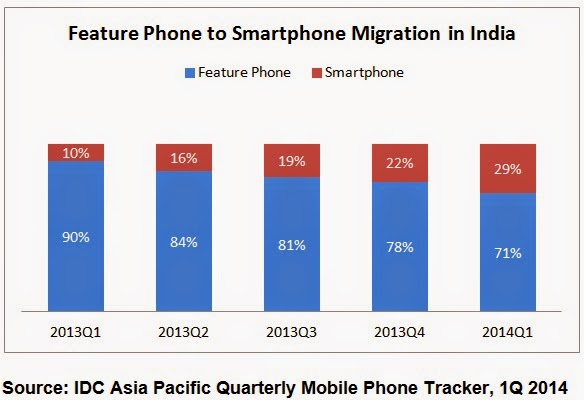
IDC Asia Pacific Quarterly Mobile Phone Tracker, 1Q 2014 points out that India was the highest growing market in Asia Pacific with a year-on-year Smartphone shipment growth of over 186% in 1Q 2014.The vast majority of the country’s user base migrated to Smartphones from feature phones and as a result Indian Smartphone market outshone other emerging markets like China which registered a year-on-year growth of 31% in 1Q 2014.


Mobango, which is among the largest independent free Apps Games and Video store, saw a dramatic increase of over 56% in the number of Android downloads in 2013 primarily due to users shifting from feature phones to Android powered Smartphones. Of this, India was the single largest contributor of game downloads at over 45m downloads.

Almost all interviews of top honchos from Flipkart, Myntra, SnapDeal and others talk about how more & more of their sales are coming from Mobile devices. http://bit.ly/Vf9Rn0

Mostly, the reason for Mobile being absent from marketing plans or why a lot of companies still do not have a mobile strategy, is lack of information on what they can do and how. So let's try and list a few things one can do from the Mobile Perspective.
  • First comes the website. Is your website mobile ready? Which could either be a customized site for mobile devices or making your website responsive so that it can render correctly based on the device the person is browsing from.
  • Next comes apps. Now not all businesses or brands need to have apps. But if it can add value to your customer then do work on that.
  • Search is as important on the mobile as on the desktop, if not more, so are your targeting mobile users in your search ads?
  • SMS is still a very good way to keep connected with your customers. And no, am not talking of spam sms messages to anyone and everyone using bought out databases from the market. What I am talking of is permission based messaging to keep your customers informed of offers, new arrivals, loyalty points,and other things that can be of value.
  • More emails are now being read on mobiles than on desktops so check if your emails are now mobile friendly?
  • Banner advertising or display as it is called is also on mobiles? It could be in-app banners or website banners. Have you tried the same?
  • QR codes can help get users reach your website, know more about your products or services or participate in a contest or just see a brand video. Are you using QR codes wisely?
  • Location based services can help get people to your outlet or know about special offers close to them. Are you looking at who your customer's are from this perspective and if you can use this as a tool to get them in?

Whether it be marketing, selling, attracting new customers, getting old ones back, engaging with  customers, CRM, notifications on special offers and new arrivals, or something else, Mobile can be used for anything and everything. Plus, the Mobile, is a personal device and, it is also almost always on. It's the one device people take with them almost everywhere. So if you haven't then it is high time to start thinking how you can use this devise to connect with your customers, current and potential, better.


A few do's and don'ts to keep in mind while thinking mobile.

  • Use only what suits your business and adds value to your customer.
  • Do not be intrusive and do not spam.
  • Be time and culture conscious.
  • Think consumer and what they want and will appreciate and not just what you can give them.
  • Remember apps have to be downloaded, installed and opened and used. So just creating one is not the end all.
  • And last but not the least, test, analyze, adapt and change and keep doing that.


That's it for a start. Think Mobile. Think Customer. Get started. If you are already using Mobile for your business then do share your learning. If you have questions or opinions to share please feel free to comment below. 


Thursday, August 7, 2014

Problem Solution

Once when I was home from engineering college for the holidays, I happened to go to my father's office. There, in his room, on the soft board, I saw a typed out message on a plain A4 sheet of paper. And it read - 

" Are you here with a solution?
OR
Are you part of the problem?"

I remember asking my Dad why he had put it up and he said "Oh I read this somewhere and liked it, and it has helped to get my team thinking about solutions rather than problems."

Later on, he explained that he realized, people had a habit of coming in to his cabin with all type of problems and asking for solutions when they themselves were very capable of finding the solutions. By encouraging his team to come to him with solutions, he had been able to nurture a team of thinkers rather than followers, and it had helped him and them excel and grow, faster than their peers in other departments. It became the department that got things done and accepted the most impossible of tasks and accomplished them well.

Well  somehow that stuck with me. I started to look at everything from a solutions perspective rather than a problem perspective. So now whenever someone spoke to me about an issue, or when someone bitched about someone else, I would spend less time sympathizing with them or bitching along with them and more time suggesting solutions. It became a sort of a second nature to me. And it has helped me tremendously in life in general and in work in particular.


When faced with a problem most of us start with "why it happened?", Or "how it happened?" Or, "because of whom it happened?". Well till here is still ok. Dwelling some more on the problem starts to get us thinking on "Oh Why me?", "Oh Why Now?", "How this will impact me?", "What will others think?" and even "Oh why does this happen to me only". As many of us would agree - now we are on the downhill path, and, the more we dwell on these things the faster we slide down & away. Self pity sinks in, loathing towards the world and everything around us starts to happen and soon we are in this "Oh poor me" frame of mind that we forget that problems are just part of life and so are solutions.


A problem is just a solution waiting to happen. But let's face it - some of us are problem oriented and some solution oriented. Right? Yes. But can we change? Yes. How? Well a simple approach could be to
  • First acknowledge there is a problem. Acknowledgement is the first step to dealing with it.
  • Think what could be the worst outcome. The absolute worst. That way we are done thinking our worst fears, then & there.
  • Now that we know what could be worst, lets also think what all could happen if we found a solution to the problem. All the positives.
  • And start looking at all probable solutions. Don't shoot down ANY solution, think of all possible solutions that we can think of. However bizarre.
  • Start working on the most practical looking solution or discuss the same with someone close. Remember - Discuss the solutions more than the problem. And start working on it.
  • Keep working on the solutions one after the other till one works. You will notice that as you work on the solutions, more possibilities will appear and chances are you will find a way out. 
  • Celebrate the working to a solution. Enjoy the process. That will help you to focus on the joy of solution hunting rather than the sorrow of dwelling on the problem itself.
  • If for any reason none of the solutions work, you will realize that the problem itself has lost significance and life goes on as you are concentrating on other things more important than the problem itself.

Looking for solutions also makes a person become more positive in his / her approach to everything in Life, more confident of oneself and overall more at peace internally. So try it. And do let me know if it helped you. If it didn't, then think what more, what else, you can do about it and then, let me know :-)